
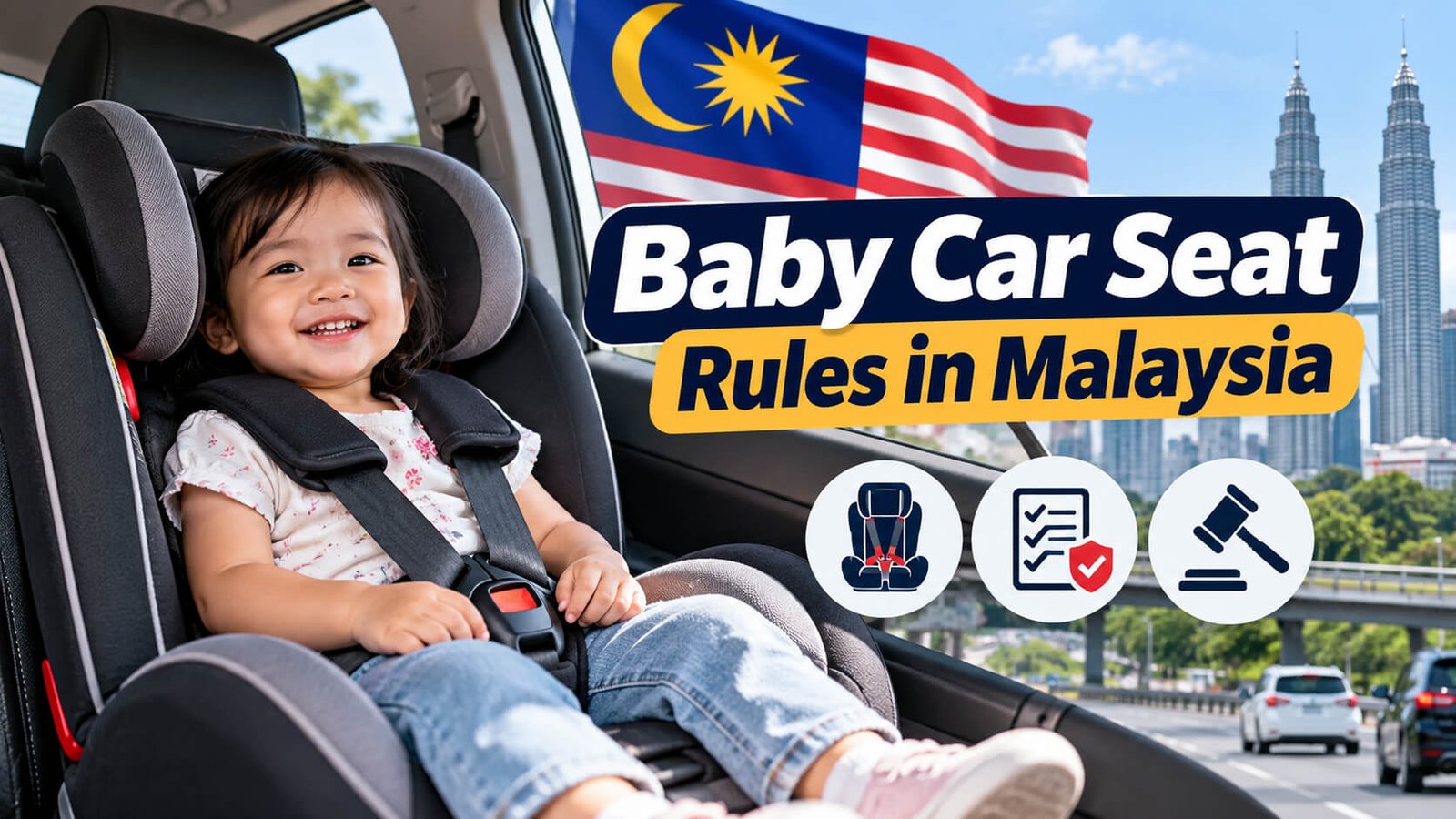
Malaysia has required child car seats by law since 2020, yet most children on its roads still aren’t properly secured. Research from the Malaysian Institute of Road Safety Research (MIROS) puts compliance at only around 30%, years after the rule took effect.
Part of the confusion is that enforcement has been handled in stages, with officers focused on education rather than tickets. That doesn’t change the underlying safety case: a correctly fitted, age-appropriate seat cuts a child’s risk of death or serious injury dramatically compared with an adult seatbelt alone.
This guide covers what Malaysian law actually requires, how to pick the right seat for your child’s age and weight, how it should be installed, what happens if you’re caught without one, and what Singapore parents driving into Malaysia need to know.
What The Law Says
Malaysia’s child restraint system (CRS) requirement is gazetted under the Road Transport Act 1978 (Motor Vehicles [Safety Seat-belts] [Amendment] Rules 2019) and took effect on 1 January 2020 for private vehicles .
| Detail | Requirement |
| Who must be in a CRS | Children under 36 kg, or under 136 cm tall, or under 12 years old (whichever applies) |
| Seat standard | Must comply with UN Regulation R44 or R129, shown by an orange ECE label on the seat |
| Vehicle types covered | Private vehicles |
| Effective date | 1 January 2020 |
| Enforcement status | Advocacy and education-first; full ticketing enforcement has not been rolled out nationwide |
Why enforcement has lagged: Officials have said checking a child seat properly needs more technical training than checking a seatbelt, and police and JPJ officers have not been fully equipped for it. A Sarawak JPJ statement in 2023 confirmed the department was still in an “awareness stage” with no summonses issued for non-compliance. As of late 2025, MIROS and medical groups were still calling for the rule to be enforced rather than only advised.
The practical takeaway: the law is in force and your child is required to be in a compliant seat, even though you are unlikely to be stopped specifically for it today. Safety researchers and doctors are unanimous that families should not wait for enforcement to start using one.
Choosing The Right Seat By Age and Size
No single seat covers a child from birth to age 12. Most families need two or three stages as their child grows. Match the seat to your child’s current weight and height, not just their age.
| Stage | Approx. age | Weight / height | Seat type | Direction |
| Infant | Birth to ~15 months | Up to about 83 cm | Rear-facing infant seat | Rear-facing |
| Toddler | ~1 to 4 years | 9–18 kg, roughly 71–100 cm | Forward-facing seat with harness | Forward-facing |
| Young child | ~4 to 10 years | 15–25 kg, under about 135 cm | Booster seat with backrest | Forward-facing, using car seatbelt |
| Older child | Up to 12 years | Under 36 kg or under 136 cm | Booster cushion, or seatbelt alone once they pass the height/weight threshold | Forward-facing |
- Keep your child rear-facing as long as the seat allows. Rear-facing is safer for infants and toddlers because it spreads crash force across the back and head rather than the neck. Most convertible seats allow rear-facing well past 15 months; follow the seat’s own weight and height limits rather than switching at a fixed age.
- Don’t rush to a booster. A child who has outgrown a harnessed seat by weight but is still short for their age benefits from staying in a high-back booster rather than moving straight to a seatbelt.
- Check the label. A genuine seat carries an orange ECE label showing it meets UN R44 or R129. Seats without this label, including some cheap or second-hand imports, may not meet the legal standard.
Installation: Getting It Right
A seat that meets the standard still fails to protect a child if it’s fitted incorrectly. MIROS notes that checking installation is one reason enforcement has been slow, since it takes more than a glance to confirm a seat is safe.
- Position: The back seat is safest for all child seats. If a rear-facing seat must go in front, the front passenger airbag should be deactivated, as an inflating airbag can seriously injure a rear-facing infant.
- Secure fitting: The seat should not move more than about 2.5 cm (an inch) side to side or front to back once installed. Use the car’s ISOFIX anchors or the seatbelt, following the seat manufacturer’s instructions exactly, not general guesswork.
- Harness fit: Straps should lie flat, not twisted, and sit snugly against your child’s body. For rear-facing seats, harness slots should be at or just below shoulder height; for forward-facing seats, at or just above.
- Recline angle: Rear-facing infant seats need the correct recline angle so a newborn’s airway doesn’t collapse; follow the seat’s built-in level indicator.
- Get it checked: A certified Child Occupant Safety Instructor (COSI) or JPJ can advise on correct installation. If you’re unsure, many baby stores that sell car seats offer a fitting check at purchase.
Penalties For Non-Compliance
There is no separate, publicly confirmed compound amount specific to the child seat rule; it falls under the same Motor Vehicles (Seat Belts and Child Restraint Systems) Rules 1978 (Amendment 2019) that also covers adult and rear seatbelts. Related seatbelt offences under this framework currently carry a compound of up to RM300.
Malaysia is also moving to raise the general maximum compound for many traffic offences from RM300 to RM500, under amendments to the Road Transport Act, though this higher cap is planned to start only from 1 January 2029 .
In practice, officers today are more likely to advise and educate than issue a summons specifically for a missing or incorrect child seat, as enforcement remains in an advocacy phase in most states. That is a reason to plan ahead, not a reason to skip a seat: a child without one is unprotected in a crash regardless of whether a ticket follows.
Driving into Malaysia From Singapore with a Child
Singapore’s own child restraint rule is stricter in one respect: children aged 8 and under must be in an appropriate child restraint and cannot simply sit on an adult’s lap. Bring that same seat across the Causeway or Second Link; it satisfies Malaysia’s requirement too, since both sides expect a UN R44 or R129 compliant seat.
- Driving your own car: Bring your existing car seat with you. It doesn’t need separate approval for use in Malaysia as long as it carries the ECE label.
- Renting a car in Malaysia: Ask the rental company whether a car seat is included or can be added; not all do, and quality varies. If you’re travelling with your own seat, most airlines and car types allow you to bring and install it yourself, which guarantees a seat you trust.
- Taxis and ride-hailing: Standard taxis and e-hailing cars in Malaysia generally do not provide child seats. If you don’t have your own with you, consider a private driver service that offers one, or avoid relying on taxis for trips with a young child.
- Public transport with young children: On buses and trains, young children are held rather than restrained, so the car-seat requirement doesn’t apply, but hold them securely and avoid standing with an infant when the vehicle is moving.
Buying a Seat: Cost and Where to Get Help
A basic compliant seat starts from around RM200; convertible seats that last through several stages cost more but can save money over buying separate stages .
MyCRS subsidy: The government ran a MyCRS incentive programme offering a 50% subsidy, up to RM150, for B40 and M40 households buying a child seat. The original 2022/2023 round has concluded, and as of late 2025 lawmakers were publicly calling for it to be reintroduced given low compliance rates. Check mycrs.gov.my for whether a new round is open before assuming it’s unavailable.
What to look for when buying:
- An orange ECE label confirming UN R44 or R129 compliance
- A seat sized to your child’s current weight and height, not just age
- ISOFIX compatibility if your car has ISOFIX anchor points, for a more secure and consistent fit than a seatbelt-only install
- A model that fits your specific car; test-fit before buying where possible, since not every seat suits every back seat shape
- Avoid buying second-hand unless you know the full history; a seat involved in even a minor accident may have invisible damage
FAQs
At what age can a child in Malaysia stop using a car seat?
When they exceed all three thresholds: 36 kg, 136 cm tall, and 12 years old. Many children reach the height or weight limit before turning 12, but the law applies until whichever threshold is reached.
Is the child car seat law actually enforced in Malaysia?
It has been in force since 1 January 2020, but enforcement has largely remained in an advocacy and education phase rather than routine ticketing, and this varies by state. Compliance is required regardless of whether you are likely to be checked.
Can my child sit on an adult’s lap instead of a car seat?
No. The law requires a compliant restraint system for children under the weight, height or age thresholds, in both Malaysia and Singapore.
Do I need a different car seat for Malaysia if I already have one from Singapore?
No. A seat that meets UN R44 or R129 (shown by the orange ECE label) satisfies the rule in both countries. Bring your own seat across the border rather than relying on a rental or taxi to provide one.
Is there still a subsidy for buying a child seat in Malaysia?
The original MyCRS subsidy round for B40 and M40 households has concluded. Check mycrs.gov.my for whether a new round has opened, as lawmakers have called for it to return.
Where should the car seat go in the vehicle?
The back seat is safest for all ages. If a rear-facing seat must be installed in the front, disable the front passenger airbag first.
Final Thoughts
Malaysia’s child car seat law has existed since 2020, but patchy enforcement has left compliance at around 30% of children nationally. That gap between law and practice doesn’t change the underlying facts: a correctly chosen, correctly fitted seat is one of the most effective ways to protect a child in a crash, with researchers citing reductions in injury risk of over 70% compared with an adult seatbelt alone.
The practical approach for any parent driving in Malaysia, whether resident or visiting from Singapore, is the same: pick a seat that matches your child’s current weight and height rather than their age alone, check it carries a genuine ECE label, install it correctly in the back seat, and keep using it right through to the point your child genuinely outgrows it. Rules may catch up with enforcement later; a properly restrained child is protected either way.
Sources
- https://www.mjphm.org.my/how-safe-are-our-children-in-vehicles-on/
- https://www.theborneopost.com/2023/10/26/jpj-sarawak-no-enforcement-orders-for-child-seat-use-yet/
- https://www.freemalaysiatoday.com/category/leisure/2025/11/27/why-arent-child-car-seats-more-widely-used-in-malaysia
- https://www.freemalaysiatoday.com/category/nation/2025/10/22/bring-back-subsidy-for-child-safety-seats-govt-urged
- https://www.flyfm.audio/bring-back-subsidy-for-child-safety-seats-govt-urged/amp/
- https://www.thevibes.com/articles/news/112669/mandatory-seatbelt-use-for-all-private-vehicle-occupants-to-be-enforced
- https://www.malaymail.com/news/malaysia/2026/06/24/some-things-you-should-know-about-malaysias-proposed-new-traffic-law-including-minimum-rm500-speeding-fine/224919

 by


