
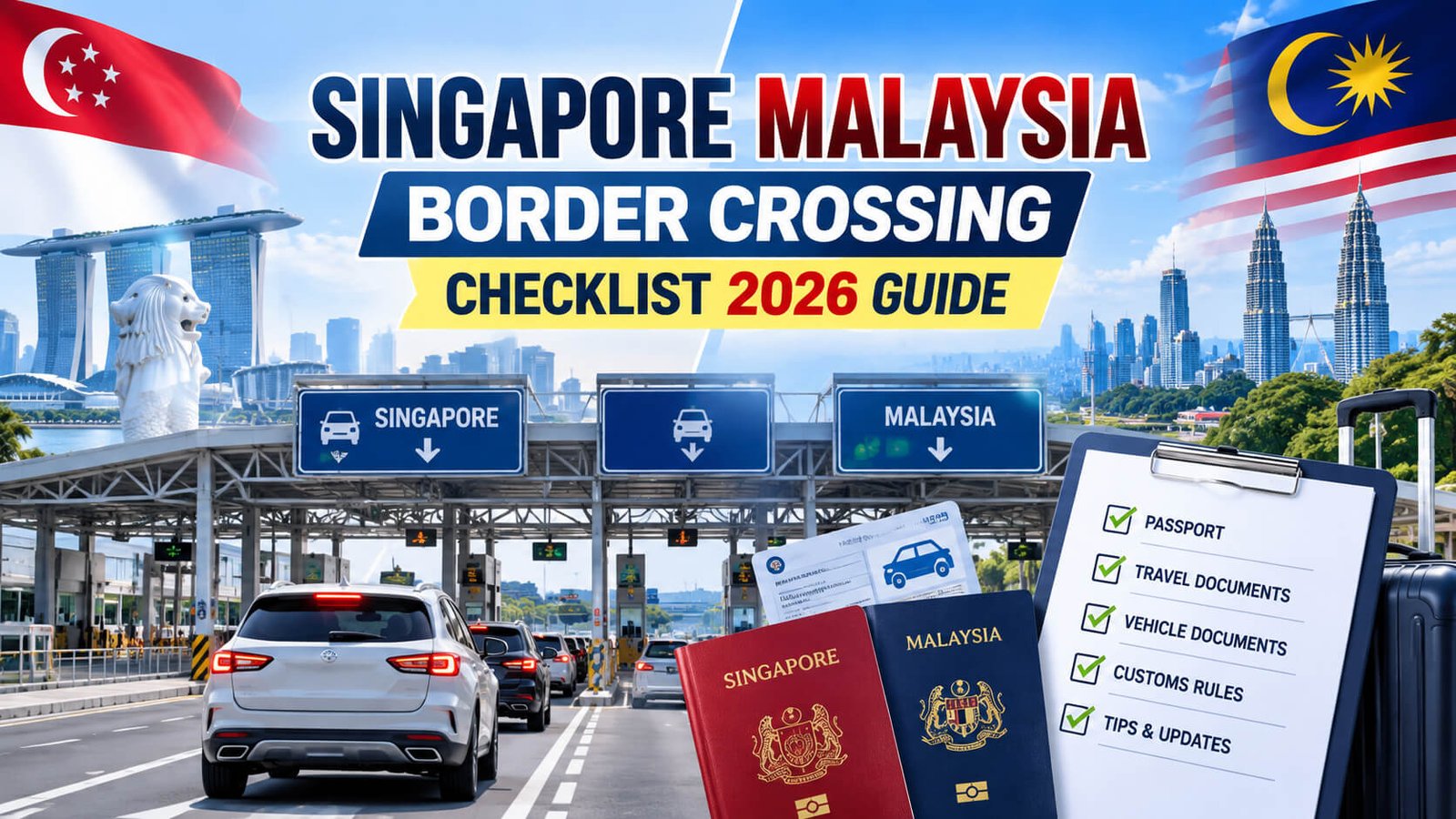
The Singapore Malaysia border crossing is the land route travelers use to move between Singapore and Peninsular Malaysia, most commonly through the Woodlands Causeway or the Second Link at Tuas. To cross legally, travelers need a valid passport (6+ months validity), a completed Malaysia Digital Arrival Card (MDAC), proof of onward travel if requested, and enough time buffer for immigration queues, which can range from 10 minutes to over 2 hours depending on the day and checkpoint.
If you’re planning this trip for the first time, the process is straightforward once you know the checklist. This guide breaks down exactly what to prepare, which checkpoint to choose, and how to avoid the delays that catch most first-time crossers off guard.
What Is the Singapore-Malaysia Border Crossing?
The Singapore-Malaysia border crossing refers to the two official land checkpoints connecting Singapore to Johor, Malaysia: the Woodlands Causeway (linking Woodlands, Singapore to Bukit Chagar/JB Sentral, Malaysia) and the Second Link Expressway (linking Tuas, Singapore to Gelang Patah, Malaysia). Travelers cross by car, bus, motorcycle, train (via JB Sentral), or on foot, passing through Singapore’s Immigration & Checkpoints Authority (ICA) and Malaysia’s Immigration Department on either side.
This is one of the busiest land borders in the world, with hundreds of thousands of crossings recorded daily during peak periods such as weekends and public holidays. Because both countries maintain separate immigration checks on entry and exit, every crossing regardless of transport mode requires two passport stamps or scans: one exiting Singapore, one entering Malaysia (and the reverse on your way back).
Singapore Malaysia Border Crossing Checklist
Here is the core checklist every traveler should complete before heading to the checkpoint:
- Valid passport — must have at least 6 months of validity remaining from your date of entry into Malaysia.
- Malaysia Digital Arrival Card (MDAC) — completed online within 3 days before arrival; this replaced the old paper arrival card and is mandatory for all foreign nationals.
- Singapore departure card / SG Arrival Card — required if you plan to re-enter Singapore, submitted digitally in advance.
- Vehicle documents (if driving) — VEP (Vehicle Entry Permit) tag for Singapore-registered vehicles entering Malaysia, valid road tax, and insurance.
- Proof of accommodation or onward travel — occasionally requested by Malaysian immigration officers, especially for longer stays.
- Sufficient time buffer — build in at least 45–90 minutes extra during peak hours (Friday evenings, weekends, and eve of public holidays).
- Local currency or a multi-currency card — for tolls (if driving), parking, and incidental costs on the Malaysian side.
- Face masks/health declarations — not currently required as of the latest update, but worth confirming before travel since health requirements have changed periodically.
Missing any single item on this list particularly the MDAC or an expired passport is the most common reason travelers get turned back or delayed at the counter.
Which Checkpoint Should You Use? Woodlands Causeway vs Second Link
The Woodlands Causeway is the older, more central checkpoint connecting JB Sentral and Johor Bahru city, while the Second Link is a newer, wider expressway crossing that connects to Gelang Patah and bypasses JB city congestion. Second Link generally has shorter queues for vehicles but is farther from Singapore’s city center and JB’s downtown.
| Factor | Woodlands Causeway | Second Link (Tuas) |
| Connects to | JB Sentral / Johor Bahru city | Gelang Patah / Nusajaya |
| Best for | Pedestrians, buses, trains, city-bound travelers | Private cars, drivers heading to KL, Malacca, or west Johor |
| Typical congestion | High, especially weekends | Moderate, generally faster for vehicles |
| Distance from Singapore CBD | ~20–25 km | ~30–35 km |
| Ideal transport mode | Walk, bus (Causeway Link, CW1/CW2), train | Private car, chartered vehicle, taxi |
If you’re taking a private car from Singapore to Johor Bahru or continuing onward to destinations like Kuala Lumpur or Malacca, drivers and chauffeur services often route through whichever checkpoint has lower live congestion at the time, which is one advantage of using an experienced private car service over self-driving or public buses.
How to Cross the Border: Step-by-Step
Crossing follows the same basic sequence regardless of which checkpoint you use, with only minor differences for vehicles versus pedestrians.
- Complete the MDAC online before you leave your accommodation this can be done days in advance.
- Arrive at the Singapore checkpoint (Woodlands or Tuas) and proceed through ICA exit immigration — scan your passport at an automated gate or present it at a manual counter.
- Cross the physical border — by foot across the Causeway, by bus, by train (Woodlands only), or by car via either link.
- Clear Malaysian immigration at the corresponding counter on the other side, presenting your passport and MDAC confirmation.
- Collect your entry stamp/passport scan and proceed into Johor Bahru or onward to your destination.
For drivers, an additional step applies: Singapore-registered vehicles need an active VEP (Vehicle Entry Permit) RFID tag, and Malaysian toll payments (Touch ‘n Go) should be pre-loaded before arrival at the checkpoint gantries.
Singapore Malaysia Immigration Requirements Explained
Singapore Malaysia immigration requirements center on three things: passport validity, the completed MDAC, and for drivers vehicle-specific permits. Malaysia typically grants visa-free entry to travelers from most countries for social or business visits up to 30, 60, or 90 days depending on nationality, but this varies, so travelers should verify their specific visa-exemption period before departure.
Singapore’s exit requirements are comparatively simple: valid passport and, for returning travelers, a completed SG Arrival Card if applicable. The stricter checks tend to happen on entry into Malaysia, where officers may ask about purpose of visit, length of stay, and accommodation details having a printed or digital hotel booking on hand speeds this up considerably.
Best Time to Cross: Avoiding Congestion
Border traffic peaks on Friday evenings, Saturday mornings, Sunday evenings, and the eve of Malaysian or Singaporean public holidays, when crossing times can stretch past two hours for vehicles at Woodlands. Weekday mid-mornings (10am–2pm) and late evenings on non-holiday weekdays tend to have the shortest queues at both checkpoints.
Travelers who need predictable timing for a flight connection in JB, a business meeting in Malacca, or a family trip to Genting Highlands often prefer booking a private car from Singapore to Johor Bahru in advance, since experienced drivers monitor real-time checkpoint congestion and choose the faster route on the day of travel, something self-driving tourists usually can’t do as effectively.
Private Car vs Bus vs Train: Which Crossing Method Is Best?
| Method | Speed | Comfort | Best For |
| Private car / chauffeur service | Fast, flexible routing | High | Families, business travelers, luggage-heavy trips, onward travel to KL/Malacca/Genting |
| Public bus (Causeway Link) | Slower, fixed schedule | Moderate | Budget solo travelers |
| Train (via Woodlands/JB Sentral) | Fast but limited capacity | Moderate | Solo travelers without luggage |
| Walking (Causeway only) | Slow, weather-dependent | Low | Very short day trips |
A private car eliminates the need to disembark, queue separately from your luggage, and re-board a second bus a common friction point with the public bus system, where travelers must first clear Singapore immigration, board a different bus, then clear Malaysian immigration on foot before re-boarding. For travelers heading straight to destinations like Malacca, Kuala Lumpur, or Genting Highlands after crossing, a private car service to Malacca or a private car from Johor Bahru to Kuala Lumpur avoids the extra transfer at JB Sentral entirely.
Frequently Asked Questions
What documents do I need to cross from Singapore to Malaysia?
You need a passport valid for at least 6 months, a completed Malaysia Digital Arrival Card (MDAC), and — if driving — a valid VEP tag for your vehicle. A Singapore Arrival Card is also needed if you plan to return.
How long does the Singapore-Malaysia border crossing usually take?
On weekdays outside peak hours, crossing can take as little as 15–30 minutes. During weekends, Friday evenings, or holiday periods, it can take 1–2+ hours, particularly at the Woodlands Causeway.
Which checkpoint is faster: Woodlands Causeway or Second Link (Tuas)?
Second Link generally has shorter vehicle queues since it handles less pedestrian and bus traffic, though it’s farther from Singapore’s city center. Woodlands is more convenient for those heading directly into Johor Bahru city.
Do I need a visa to enter Malaysia from Singapore?
Most nationalities receive visa-free entry to Malaysia for a set number of days depending on passport, but requirements vary by nationality. All travelers still need to complete the MDAC regardless of visa status.
Is it better to cross by private car, bus, or train?
For groups, families, or travelers continuing beyond Johor Bahru, a private car is typically faster and more comfortable since it avoids transfers and lets the driver choose the less congested checkpoint in real time. Public bus and train options suit solo budget travelers with light luggage.
Final Thoughts
Crossing the Singapore Malaysia border is routine once you’ve done it, but the checklist matters most on your first trip: passport validity, the MDAC, and a realistic time buffer are what separate a smooth crossing from a stressful one. If your itinerary continues beyond Johor Bahru whether to Malacca, Kuala Lumpur, Genting Highlands, or Desaru planning your transport in advance removes most of the uncertainty around checkpoint congestion and transfers.
For a hassle-free trip, many travelers choose to book a private car from Singapore to JB directly, letting an experienced driver handle checkpoint selection, timing, and onward routing while they focus on the trip itself.

 by


